



Key Takeaways
A keyword research checklist provides a systematic process for identifying and prioritizing keywords that drive qualified leads rather than just traffic, by aligning search terms with buyer intent, conversion goals, and business priorities. The approach evaluates keywords across multiple factors, including commercial intent, funnel stages, and competitive opportunity, while avoiding common mistakes like chasing high-volume terms that don't convert.
You've got the product. You've got the team. But if your target buyers can't find you when they search for solutions, none of that matters. Most B2B companies approach keyword research like a B2C brand – chasing high-volume terms that attract tire-kickers instead of decision-makers. A solid keyword research checklist built for B2B fixes that.
This guide walks you through a keyword research checklist that works for B2B companies. You'll learn how to find the exact terms your ideal customers type into Google, sidestep the mistakes that kill performance, and map every keyword to content that drives pipeline. No theoretical SEO lectures, just the practical steps that drive results.
Where B2B and B2C Keyword Strategies Diverge
Before you even open a keyword tool, there's a foundational problem worth addressing. Most B2B teams take their keyword research approach straight from the B2C playbook, and that's exactly where things start to unravel. The buying process, search behavior, and intent behind queries are fundamentally different. Here's why that matters.
When a consumer searches for “buy running shoes online," they're likely ready to buy within minutes. When a VP of Engineering searches for “cloud infrastructure monitoring tool," they could be six months away from signing a contract. That difference changes everything about how you should approach keyword selection.
B2C keywords tend to be short, high-volume, and transactional. B2B keywords look nothing like that. They're often longer, more technical, and scattered across multiple people who all have a say in the buying decision. A single B2B deal might involve an end user searching “how to automate DevOps pipelines,” a manager looking up “best CI/CD platforms for enterprise,” and a CFO typing “CI/CD platform pricing comparison.” Three different people, three different queries, one deal.
If your keyword research checklist only accounts for one of those searchers, you're leaving pipeline on the table. You need to capture demand across every role that influences a purchase, not just the person who clicks “Buy Now.” A strong B2B keyword research strategy accounts for this complexity from the start, mapping terms to the people who actually search them.
Your 8-Step Keyword Research Checklist
Step 1: Define Your ICP
Your ideal customer profile (ICP) shapes everything that follows. Before you open a single keyword tool, write down the job titles, industries, company sizes, and pain points of the people you actually want to reach. Knowing your ICP is the only way to filter out “bad traffic." Without an ICP, you might find a keyword with 10,000 monthly searches and think it's a goldmine, only to realize later those searchers are students or hobbyists with $0 to spend. If you know your ICP is an Enterprise CTO, you'll ignore the high-volume “free” keywords and target the low-volume “compliance” or “integration” keywords that actually signal a professional buyer.
Step 2: Establish Core Topics and Brainstorm Seed Keywords
Identify the main topics your business needs to own in search results. These become your seed themes for expansion. If you sell project management software, your core topics might include team collaboration, workflow automation, and resource planning. Each theme becomes a launching point for building out keyword clusters.
Once you have established the topics, you can start your keyword search with the obvious terms your customers use when looking for your solution. These seed keywords become the foundation for everything else. Talk to your sales team about what prospects ask for during calls. Review customer emails for exact phrases. Check your Google Search Console to see what's already bringing in some traffic.
Write down 5-10 core terms that describe your product or service. If you sell project management software, your seeds might be “project tracking tool,” “team collaboration software,” or “workflow management platform.” Keep these broad for now, you'll expand them in the next step.
Step 3: Expand Keyword Lists
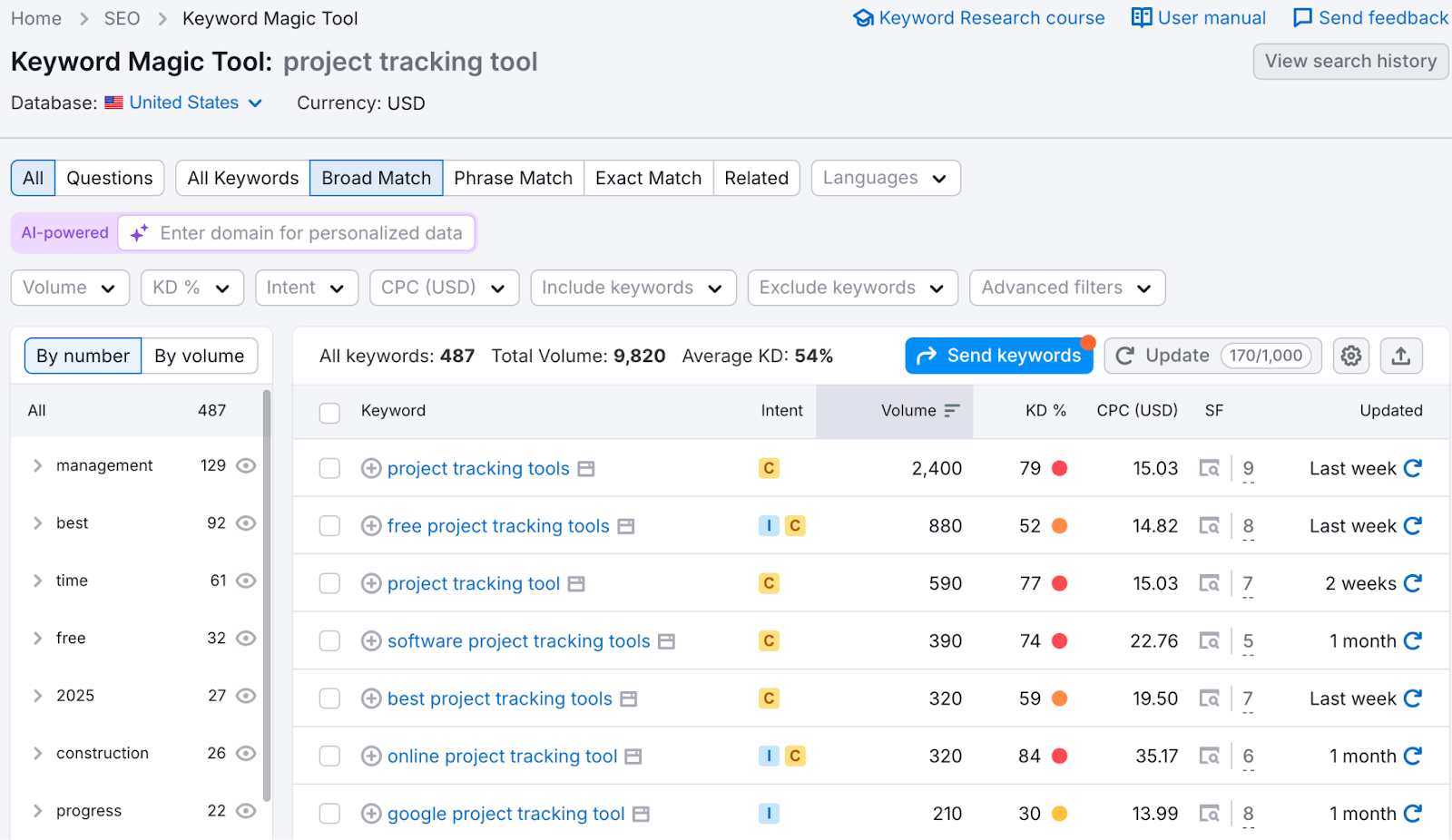
Take each seed keyword and generate related terms using keyword research tools. Tools like Semrush's Keyword Magic Tool can show you hundreds of variations, related questions, and adjacent topics people search for around your seeds.
Look for different ways people express the same need. Your “project tracking tool” seed might expand to “software project tracking tools,” “task tracking software,” or “project timeline creator.” Each variation attracts slightly different segments of your audience.
Step 4: Analyze Keyword Metrics and Search Intent
Now evaluate which keywords deserve your attention. Three core metrics help you separate winners from time-wasters:
- Search volume: How many people search for this term monthly? Higher isn't always better, balance volume with relevance to your business.
- Keyword difficulty: How hard is it to rank for this term? New sites should target lower difficulty scores (under 20) while established sites can chase tougher keywords.
Tip: Don’t ignore long-tail keywords (with 3+ words). They typically have lower search volume but higher conversion rates because they match precise intent.
For every seed keyword on your list, you can use tools like Semrush keyword overview to see the top 10 ranking pages in a specific country. If the top results are all beginner guides and you planned a product comparison page, you've got an intent mismatch. Google is telling you what searchers expect. Match that expectation or pick a different keyword. There are four intent buckets that matter here:
- Informational: the searcher is learning about a topic
- Navigational: they're looking for a specific brand or website
- Commercial investigation: they're comparing options before making a decision
- Transactional: they're ready to buy, sign up, or request a demo
Getting intent right at this stage saves you from producing content that ranks but never converts.
Step 5: Analyze Competitor Keyword Gaps
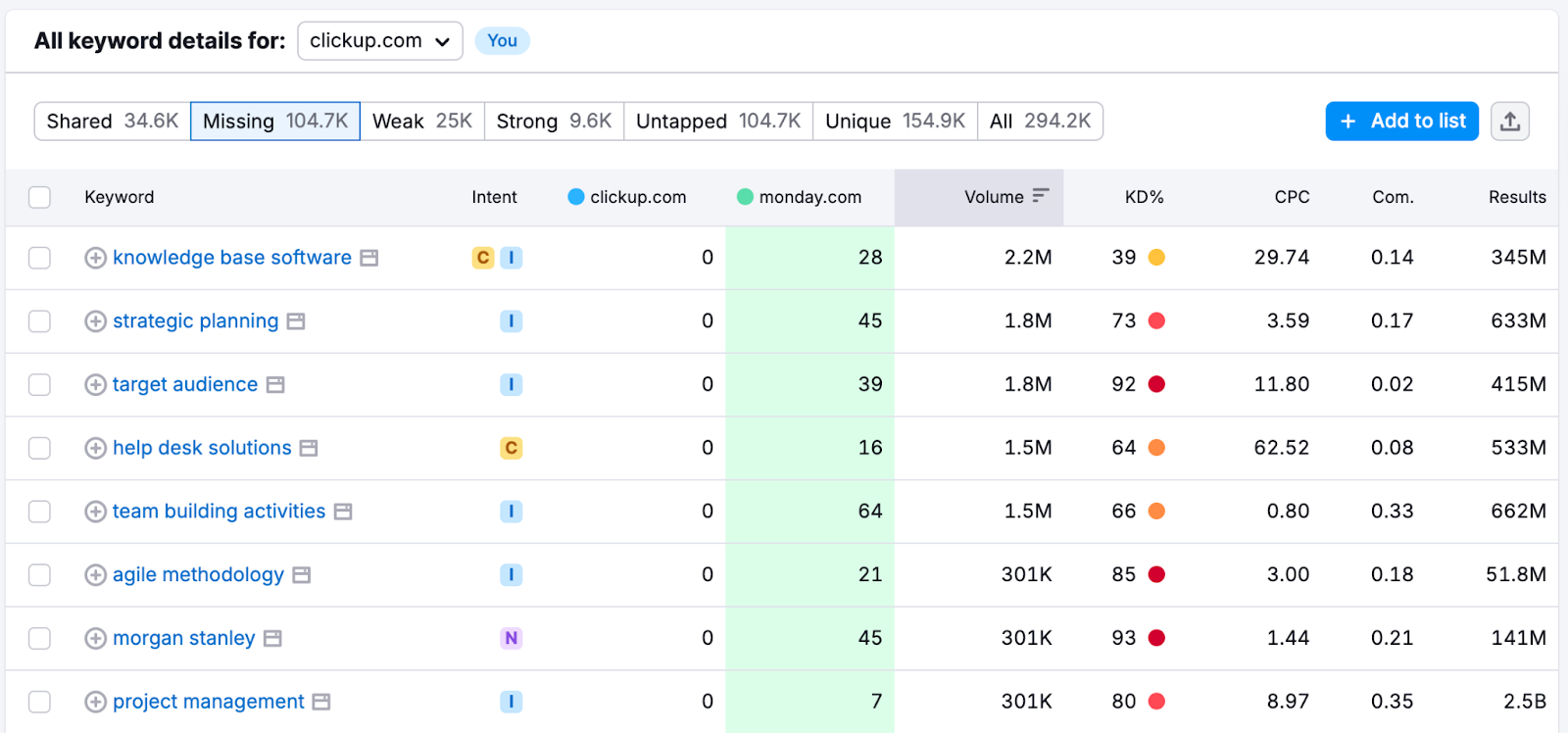
Open up Ahrefs or Semrush and run a content gap analysis between your domain and two or three competitors. This reveals proven keywords that already drive traffic in your space. For example, a comparison between ClickUp and Monday.com shows thousands of “missing” keyword opportunities where one brand has zero visibility while the other is already capturing traffic:
If you want a deeper walkthrough of this process, we've put together a full guide on competitor keyword gap analysis that breaks it down further.
Step 6: Group Keywords by Funnel Stage
Once you’ve gathered enough keywords, you must understand where your buyers are in the journey. Take your refined list and map every keyword to a specific stage. This prevents “content gaps" where you might attract thousands of researchers but zero actual buyers. Tailor your content to resonate with them at different stages of the buyer’s journey:
TOFU (Top of Funnel – Awareness):
- Keyword Goal: Broad, educational terms (e.g., “What is cloud cost optimization").
- Content Type: High-level “how-to" guides and industry trend reports that answer “What" and “Why."
MOFU (Middle of Funnel – Consideration):
- Keyword Goal: Solution-oriented queries (e.g., “Best cloud cost optimization tools").
- Content Type: In-depth technical guides, webinars, and checklists that solve specific pain points.
BOFU (Bottom of Funnel – Decision):
- Keyword Goal: High-intent comparison or transactional terms (e.g., “Cloudability vs. CloudHealth pricing").
- Content Type: Case studies, customer testimonials, and product demos that prove your solution’s ROI.
By tagging every keyword in your list as awareness, consideration, or decision, you ensure a balanced strategy. This systematic approach, especially when paired with a process for producing Content At Scale makes sure you can actually fill every stage without bottlenecks.
Step 7: Prioritize Based on Business Impact
Not all keywords deserve equal attention. Score each keyword based on potential business value. A keyword with 100 monthly searches that attracts qualified B2B leads beats one with 5,000 searches that brings tire-kickers.
Score each keyword on three factors:
- Business relevance: does this query relate to what you actually sell?
- Ranking difficulty: can you realistically compete for a first-page position?
- Conversion potential: is the searcher close to a buying decision?
A simple 1-3 scale for each factor works well. Multiply the scores together and sort in descending order. The keywords at the top of that list are where you start creating content first. Everything else goes into a backlog you can revisit once the high-impact pieces are live.
Step 8: Map Keywords to Content Types and Pages
Every keyword needs a home. Some keywords fit existing pages that need optimization. Others require new content. Don't assign two keywords with the same intent to the same page, that causes internal cannibalization where your own pages end up competing against each other in search results. This confuses search engines about which page to rank and typically results in neither page performing well.
The rule is straightforward: one primary keyword per page, supported by two or three semantically related secondary terms. Document everything in a spreadsheet with these columns:
- Keyword: the exact term you're targeting
- Intent: informational, commercial, transactional, or navigational
- Funnel stage: TOFU, MOFU, or BOFU
- Assigned URL: the page that will target this keyword
- Target publish date: when the content goes live
That spreadsheet becomes your content roadmap: the one source that keeps your team aligned and prevents duplicate effort across writers, SEO leads, and product marketers.
Common Mistakes That Tank B2B Keyword Performance
You can nail every step of your keyword research checklist and still fail if you fall into common workflow traps. Let's examine the specific problems that derail keyword research workflows and how to avoid them.
Chasing Traffic Instead of Buyer Intent
This is the number one mistake B2B teams make. They see a keyword with 10,000 monthly searches and immediately add it to their content calendar without asking what those searchers actually want. A keyword like “free project management templates" might bring thousands of visitors, but if you sell enterprise project management software, those visitors are looking for something completely different than what you offer. Check the search intent before putting resources toward this. Look at what currently ranks for your target keywords.
Instead, prioritize keywords where the intent matches your conversion goals. Someone searching “enter prise project management software comparison" is evaluating solutions. That's the traffic you want, even if the search volume is lower. These visitors are closer to making a purchase decision and are far more likely to request a demo or contact your sales team.
Skipping Keyword Clustering
Some teams treat every keyword as a separate opportunity and create individual pages for closely related terms. This leads to thin content, cannibalization issues, and a disorganized site structure. Search engines get confused about which page should rank for what, and your pages end up competing against each other instead of complementing each other.
Cluster related keywords into topic groups. Build strong pillar content that addresses the main topic, then create supporting content for subtopics. Instead of ten mediocre pages targeting similar keywords, you build one authoritative piece that ranks for multiple related terms.
How Entlify Supports Structured Keyword Research
A keyword research checklist only drives results when it’s executed consistently. The gap between teams that struggle with organic growth and those who consistently meet their targets usually comes down to having a solid process. Without structure, even strong research turns into disconnected spreadsheets, duplicated efforts, and missed opportunities. When you build a strategic foundation, tackle it systematically, focus on business impact instead of vanity metrics, and avoid the workflow traps that drain resources, your keyword research becomes a real competitive edge.
If your current keyword strategy feels fragmented or disconnected from growth goals, it may be time to approach it with more structure. Entlify helps B2B companies move beyond scattered keyword lists into a system that aligns SEO with real business outcomes. Contact us to see how structured processes can accelerate yourgrowth. Our team works alongside you to turn keyword research into a repeatable engine for qualified traffic and measurable revenue impact.
FAQs
How do you decide which keywords are most important in your research?
Prioritize keywords by scoring them across multiple factors: search volume, keyword difficulty, commercial intent, alignment with your offerings, and conversion likelihood. The highest-value keywords are those that match specific buyer intent and fit your team's ability to create authoritative content, even if they have lower search volume than broader terms.
What's the fastest way to validate if a keyword will actually drive conversions?
Check what type of content currently ranks in the top 10 results and whether those pages match your conversion goals. If you're selling a solution but only informational blog posts rank, the keyword signals research intent rather than buying intent, which means it's unlikely to drive qualified leads regardless of traffic volume.
What is the best way to come up with B2B keyword ideas?
Start with sales call recordings and support tickets to capture the exact language your buyers use, then expand those seed terms using tools like Ahrefs, Semrush, Google autocomplete, and “People Also Ask" results.
Can I use ChatGPT for keyword research?
Yes, but primarily for brainstorming and mapping. While ChatGPT is excellent for generating seed ideas, identifying pain points, and clustering keywords by intent, it lacks live access to actual search volume and competition data. Use it to build your initial list and content strategy, then validate those terms with a dedicated SEO tool to ensure they have enough traffic to justify the effort.