



Key Takeaways
A GEO audit evaluates how your brand appears across AI search platforms like ChatGPT, Perplexity, and Google AI Overviews, identifying where you're mentioned, where you're missing, and how you compare to competitors.
If your brand doesn't appear when someone asks ChatGPT, Perplexity, or Claude for a recommendation, you're losing deals you never knew existed. A GEO audit shows you exactly where you stand in AI-powered search results, what's driving visibility, and what's killing it.
AI engines are changing how buyers discover and evaluate solutions. Your generative engine optimization performance isn't optional to track anymore.
This guide covers what a GEO audit actually involves, the specific problems it uncovers, and what matters in a GEO audit tool. We'll break down the core components of a technical GEO audit and show you how to run a free GEO audit on your brand right now.
What Is a GEO Audit and Why Does It Matter?
A GEO audit is a structured review of how your brand shows up across AI-powered search engines: platforms like ChatGPT, Perplexity, Google AI Overviews, and others. It tells you whether these systems mention, recommend, or cite your brand when users ask relevant questions.
A Quick Distinction of GEO vs. SEO
SEO is about ranking your pages in traditional search results: the classic blue links on Google. GEO is about getting your brand cited or recommended inside AI-generated answers. We broke down this distinction in detail in our GEO vs. SEO guide. The short version: SEO gets you ranked. GEO gets you mentioned.
Why a Technical GEO Audit Matters for AI Visibility
A technical GEO audit examines whether your content is structured in a way that LLMs can actually process and retrieve, because these models pull from training data, live web search, or a mix of both when generating answers. If your site lacks clear entity signals, structured data, or authoritative citations, AI tools will simply pull from someone else.
Think of a technical GEO audit as an evaluation of how AI “reads" your brand. It flags problems like missing structured markup, weak topical authority, and content that AI can't easily parse into direct answers. For B2B SaaS companies, especially where buyers increasingly ask AI tools to shortlist vendors before ever visiting a website, this kind of audit has a direct line to pipeline. If you're already investing in SEO, the audit will show you which impact SEO has on GEO.
Common Visibility Problems in AI-Driven Search
Here's what typically goes wrong when brands ignore their presence in generative search. AI models pull information from multiple sources, and if those sources are outdated, inconsistent, or dominated by competitors, the output reflects exactly that, not what you'd want a potential buyer to see.
The most frequent issue? Your brand simply doesn't show up. A buyer asks ChatGPT or Perplexity for “best B2B marketing agencies for SaaS" and gets a list of five names. Yours isn't one of them. You never even knew you were excluded from the conversation. This is closely tied to the rise of zero-click content, where users get their answers without ever clicking through to a website.
The second problem is inaccuracy. AI tools might mention your company but describe your services wrong, attribute features you don't offer, or confuse you with a similarly named brand. This erodes trust before a prospect ever lands on your site. And because these answers feel authoritative to users, correcting the impression later becomes an uphill battle.
Third, competitors who have run a GEO audit are actively optimizing their content for AI citation. They're structuring pages with clear entity definitions, building topical authority clusters, and earning mentions across sources that LLMs favor. This kind of optimization falls squarely within what's known as LLMO (Large Language Model Optimization), and every day you wait, the gap widens.
The Real Cost: Lost Traffic, Wasted Budget, and Missed Revenue
Let's make this concrete. Running paid campaigns or investing in content marketing becomes less effective when AI-driven search directs your audience to competitors before they even reach Google's organic results. Your cost per acquisition rises, the pipeline shrinks, and you spend the same budget for fewer outcomes.
The table below breaks down what happens when you skip a GEO audit compared to running one, across five key areas that directly affect your bottom line:
This isn't just a visibility issue, it's a revenue issue. For SaaS companies selling to other businesses, the buyer journey often starts with research queries directed at AI assistants. If your brand is missing from those responses, you're not even making it onto the consideration list. A GEO audit tool gives you the data to fix that. Without it, you're optimizing for a search ecosystem that's already shifted underneath you.
The GEO Audit Process: Step by Step
Knowing you need a GEO audit is one thing. Actually running one is another. Here's a practical breakdown of the process so you can start getting real answers about your AI visibility.

Step 1: Evaluate Content Structure (Technical GEO audit)
AI models favor content that is well-organized and easy to break into direct answers. Use this checklist to ensure your pages are “machine-readable" and citation-ready:
- Audit your headings and subheadings: Check whether they directly answer questions buyers ask AI engines, rather than just targeting traditional SEO keywords.
- Review structured data markup: Confirm your pages use schema (like FAQ, Organization, or Product), which acts as a “translator" for AI. That helps AI crawlers extract key brand attributes without ambiguity.
- Evaluate content clarity: Identify sections where claims lack supporting data or clear definitions: AI models favor specific numbers and literal “is-a" definitions when generating citations.
- Check third-party references: Map how many reputable external sources mention your brand, as AI models weigh third-party validation heavily when deciding what to cite.
- Compare against cited competitors: Analyze the content AI engines are actually referencing for your target queries and note what those pages do differently from yours.
Running through this technical checklist manually can surface structural gaps, but it doesn’t always show how AI engines are currently interpreting your brand. That’s where an external diagnostic can help.
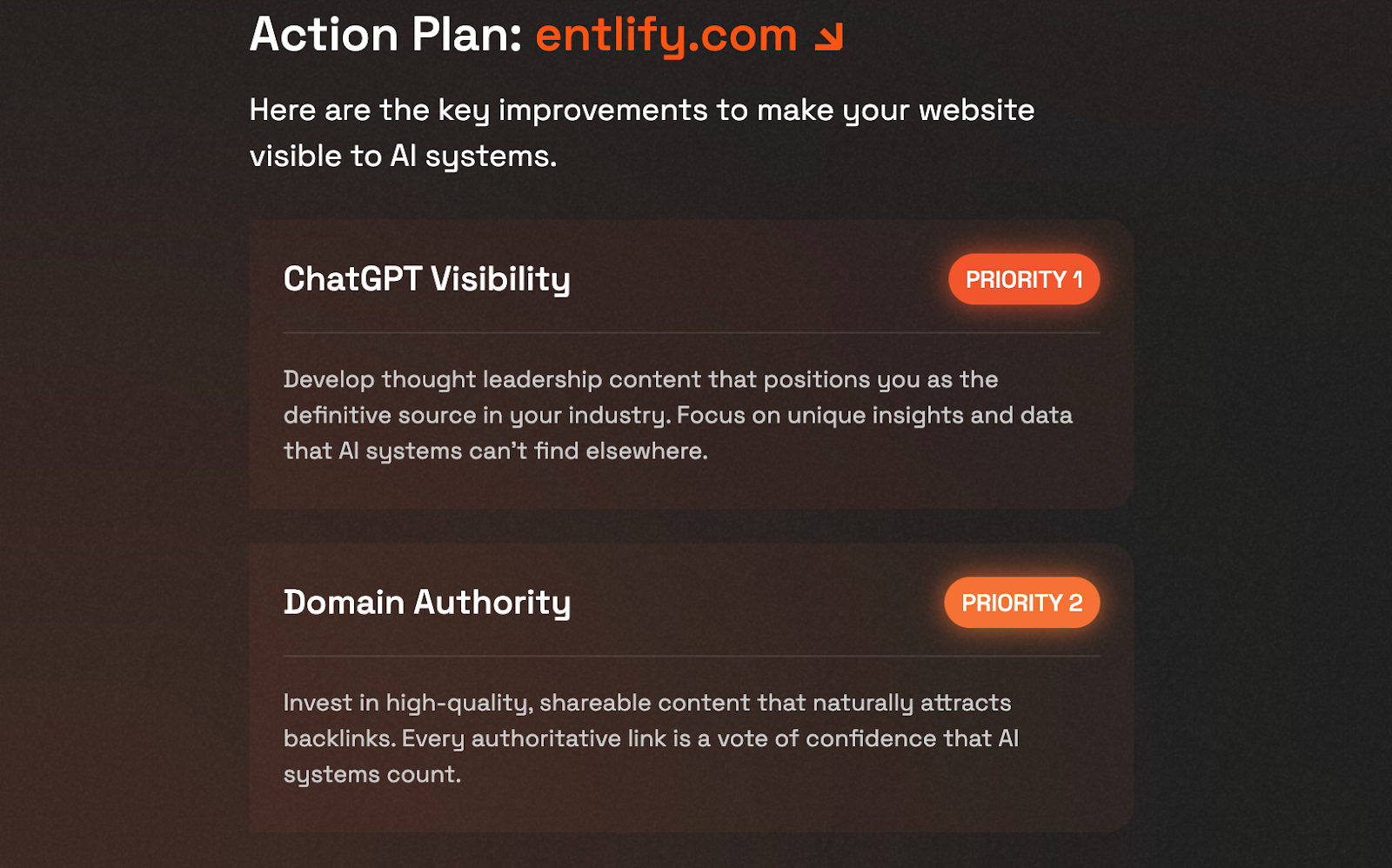
Entlify built a free GEO audit tool specifically for B2B teams that want a clear, one-time snapshot of their AI visibility. You enter your company details, and the tool runs queries across major generative engines to evaluate how your brand appears at that moment. The report highlights visibility gaps, flags inconsistencies, and benchmarks your presence against competitors.
It’s an audit report, not a continuous monitoring platform. It does not provide ongoing tracking or live alerting. Instead, it delivers a structured visibility assessment you can use to identify structural issues and prioritize improvements based on current AI search behavior. If you want to understand how machine-readable and citation-ready your brand is today, run our GEO audit tool to get a practical starting point before making broader structural changes. The output connects directly to action, so you don't just get a score, you get a prioritized list of what to fix first.
Step 2: Benchmark Your Current AI Visibility
You can’t improve what you haven’t measured. Start by querying the AI platforms your buyers actually use, such as ChatGPT, Perplexity, Google AI Overviews, and Claude, with the same questions your target audience would ask. Think along the lines of “best [your category] tools for [use case]” or “what companies offer [your service].” However, don’t run these tests from your own logged-in account. AI systems can personalize or sugarcoat results based on prior interactions, brand familiarity, or session history.
Document every response carefully. Screenshot them. Record whether your brand appears, how it’s positioned, and what the AI says about you. And don’t rely on a single query. Generative AI outputs vary from prompt to prompt, so you need to test multiple times and track visibility consistently over time. This manual process is simply a starting point: a snapshot to understand where you stand today. It’s not a scalable or continuous solution. Later in this article, we’ll explore how automation can help you monitor AI visibility consistently over time. For now, this initial audit gives you the baseline you need. Without it, any optimization you implement later is just guesswork.
Step 3: Analyze Brand Mentions Across AI Platforms
AI engines pull data differently. ChatGPT might cite you accurately while Perplexity ignores you entirely. Run your queries across at least three different platforms and compare the results side by side. Pay close attention to whether AI mentions your brand by name, links to your content, or attributes your offerings correctly. If one platform gets your product description wrong or confuses you with a competitor, that's a data integrity problem. And it usually needs to be fixed at the source. That means improving how third-party sites and your own pages describe your brand, your products, and what you actually do.
Step 4: Identify Gaps and Prioritize Fixes
At this point, you'll have a clear picture of where your brand stands. Next, turn that picture into a prioritized action plan. Here's the sequence that tends to deliver the fastest results:
- Fix inaccuracies first: If AI is saying something wrong about your brand, correct the source content: your website, your directory listings, and any high-authority pages that reference you.
- Fill visibility gaps: For queries where competitors appear and you don't, create or restructure content that directly answers those questions with clear, citable language.
- Strengthen topical authority: Build content clusters around your core topics so AI models associate your brand with specific expertise areas rather than treating you as a one-off mention. A solid keyword research strategy will help you identify which clusters to build first.
- Expand third-party mentions: Earn references on industry publications, review sites, and comparison pages that LLMs already trust as sources.
Why Automation is Critical for GEO Auditing
A manual GEO audit, copy-pasting prompts into ChatGPT or Perplexity, is a fine starting point, but it isn't a strategy. As AI models update their training data and retrieval sources in real-time, manual tracking becomes a bottleneck that leads to stale data. Using an automated GEO audit tool is critical to maintain real-time visibility. To get a cleaner baseline, use anonymous browsing sessions, fresh accounts, or specialized monitoring tools like Scrunch, designed to track AI visibility objectively.
The Value of an Automated GEO Audit Tool:
- Cross-Platform Intelligence: Instead of checking one bot at a time, automation queries multiple engines (ChatGPT, Perplexity, Claude, Google AI Overviews) simultaneously to find brand gaps.
- Data Integrity at Scale: Automation flags inconsistent brand descriptions across dozens of sources that a human would likely miss.
- Competitive Gap Analysis: Tools provide side-by-side visibility scoring, showing exactly where competitors are being cited in your place.
- From Data to Action: Rather than just giving you a “vanity score," automated reports provide a prioritized list of technical fixes and content gaps to bridge immediately.
Final Thoughts
AI search is already shaping which brands make it onto your buyer's shortlist, and which ones get skipped entirely. A GEO audit gives you visibility data that traditional analytics completely miss. It shows you where you stand, what's inaccurate, and what deserves attention first. The longer you go without that information, the more ground you hand to competitors who are actually watching this channel.
The approach itself isn't complicated: benchmark your presence, fix inaccuracies, structure your content so it gets cited, and measure progress on a regular cadence. Whether you handle it manually or lean on a GEO audit tool to move faster, what matters most is that you start. Every week without a baseline is another week of decisions built on incomplete data. And in B2B, that gap shows up directly as pipeline you never even knew you lost. If you've read this far and still aren't sure how your brand shows up in AI search, this is the fastest way to find out. Run your free GEO audit tool now and see exactly what AI engines are saying about your company before your next prospect asks them.
FAQs
What is a GEO audit?
A GEO audit is a diagnostic process that evaluates how your brand appears inside AI-generated answers from platforms like ChatGPT, Perplexity, and Google AI Overviews, checking for visibility, accuracy, and competitive positioning in those responses.
What is the difference between a GEO audit and an SEO audit?
While a traditional SEO audit focuses on keyword rankings, backlinks, and page-load speeds for search engine results pages (SERPs), a GEO audit focuses on context and citations. SEO optimizes for “clicks" from a list of links, GEO optimizes for “mentions" within a synthesized AI answer.
Should I prioritize technical changes, content restructuring, or brand building first?
Start by correcting any inaccurate information AI tools are surfacing about your brand, then move to restructuring content for citation readiness, and finally invest in building topical authority and third-party mentions to strengthen your long-term presence.
How often should I run a GEO audit to track changes in AI visibility?
Monthly is a practical starting cadence since AI models frequently update their training data and retrieval sources, meaning your brand's visibility can shift without warning between cycles.
Should a GEO audit help if my brand is already ranking well in traditional Google search?
Yes, because strong organic rankings do not guarantee that AI tools will mention or accurately represent your brand when generating answers, and many well-ranked companies discover through a GEO audit that they are completely absent from AI responses for their most important queries.