



Key Takeaways
SEO optimizes websites to rank in traditional search results and drive clicks to your site, while GEO focuses on getting your brand cited directly within AI-generated answers without requiring user clicks. The key difference between GEO vs. SEO is that one produces clickable links through ranking algorithms and the other produces zero-click brand mentions through generative AI models that synthesize information from authoritative sources.
Search is changing fast. Traditional search engines still dominate, but AI-powered search like ChatGPT, Perplexity, and Google's AI Overviews are reshaping how people find information. This shift introduces a new challenge: optimizing for generative engines (GEO) alongside traditional search engine optimization (SEO). GEO vs. SEO directly shapes your visibility strategy. SEO focuses on ranking pages that users click through to visit. GEO optimizes for AI models that generate direct answers and cite sources without requiring clicks. AI search traffic remains marginal today across most sites, but tracking and optimizing for it now creates competitive advantages. Understanding both approaches prepares you for where search is heading, not just where it's been.
GEO vs. SEO: What’s the Difference?
When you compare GEO vs. SEO, the main distinction is where your content appears and how users interact with it. SEO focuses on getting your pages to rank in traditional search results, driving traffic back to your website. GEO, sometimes referred to as LLMO or AEO, optimizes your brand to appear directly within AI-generated responses – meaning your content is cited within answers, even when users don’t always click through to your site.
Here's a practical example: when you search Google for "best project management tools", you see a list of ranked results you can click through. That's SEO doing its job. When you ask ChatGPT the same question and it generates an answer that specifically mentions Asana or Monday.com by name, that's where GEO comes into play. The fundamental outputs differ: SEO produces clickable links, while GEO produces mentions woven into synthesized responses.
Understanding what is the difference between GEO vs. SEO also means recognizing that their success metrics operate on completely different scales. SEO performance shows up in click-through rates, keyword rankings, and organic traffic numbers. GEO success manifests as source citations, brand mentions within answers, and “zero-click" visibility – your brand gains exposure even when users don’t visit your website. According to Search Engine Land, LLM-generated referrals still make up less than 1% of overall site traffic, even as AI-driven search reshapes how users engage with brand content. Based on the average data across all Entlify clients, the referral traffic from AI is approximately 5% without a clear trend line.
SEO and GEO share the same foundation: they both benefit from high-quality content, strong backlink profiles, and clear structured data that helps machines understand your brand. Where GEO goes further is in how heavily it leans on entity-building and brand presence – from authoritative coverage and digital PR to being part of conversations on platforms like Reddit and other social communities. Both approaches ultimately serve the same purpose – connecting your brand with people searching for solutions, but the routes to visibility diverge considerably between search engines and generative AI systems.
Understanding SEO: Search Engine Optimization
SEO remains the foundation of organic visibility despite the emergence of AI-powered alternatives. Search engine optimization focuses on making your content discoverable to algorithms that crawl, index, and rank billions of web pages. While the principles behind SEO have evolved over the years, the core mission stays constant: matching valuable content with user intent in ways that search engines can understand and reward.
How Traditional Search Engines Work
Search engines follow a three-stage process to deliver results. First, automated crawlers (also called bots or spiders) systematically browse the web, following links from page to page to discover new content. These crawlers analyze everything from text to site structure and loading speed. Second, the indexing phase begins: search engines process and store the discovered content in massive databases, organizing it by keywords, topics, entities, and hundreds of other signals. According to Semrush's guide to SEO, ranking factors include content relevancy and quality, backlink profiles, schema markup implementation, and site performance metrics.
The final stage involves ranking. When someone types a query, the search engine analyzes intent, scans its index for matching pages, and applies its algorithm to determine which results appear first. Google's algorithm considers over 200 ranking factors, though not all carry equal weight. Content relevance, domain authority through backlinks, page experience signals, and freshness all influence where your pages land. The algorithm constantly adjusts to prioritize what serves users best, which means your rankings can shift even when you haven't changed anything on your site.
Core SEO Strategies and Tactics
Effective SEO requires coordinated work across multiple disciplines. Technical SEO ensures search engines can crawl and index your site efficiently. This includes fixing broken links, implementing proper URL structures, optimizing site speed, ensuring mobile responsiveness, and creating XML sitemaps. On-page SEO involves optimizing individual pages through incorporating target keywords naturally into titles, headers, meta descriptions, and body content while maintaining readability. You also need to structure content with proper HTML heading hierarchy and add schema markup to help search engines understand context.
Off-page SEO builds your site's authority through external signals. Link building remains crucial: earning backlinks from reputable sites signals to search engines that your content deserves trust and visibility. Quality beats quantity here. A single link from an authoritative domain in your industry carries more weight than dozens from low-quality directories. Content marketing supports all these efforts through creating resources valuable enough that people naturally want to reference and share them. You need original research, detailed guides, case studies, or tools that solve real problems. Local SEO tactics matter for businesses with physical locations, requiring optimized Google Business profiles, consistent NAP (name, address, phone) citations, and local content.
Measurement distinguishes successful SEO from guesswork. Track organic traffic, keyword rankings, click-through rates, bounce rates, and conversion metrics. Tools like Google Search Console show which queries drive impressions and clicks, while platforms such as Ahrefs and Semrush provide competitive analysis and backlink monitoring. SEO delivers compounding returns: rankings improve gradually, but once established, they generate consistent traffic without ongoing ad spend. The timeline varies – competitive keywords might take six to twelve months of sustained effort before you see meaningful movement.
Understanding GEO: Generative Engine Optimization
Generative Engine Optimization represents a fundamental shift in how content reaches audiences. Instead of optimizing pages to rank in search results, GEO focuses on positioning your brand and expertise within AI-generated responses. AI systems like ChatGPT, Claude, Perplexity, and Google's Gemini don't just retrieve and display links – they synthesize information from multiple sources to generate original answers. This changes the rules entirely.
How AI-Powered Search Engines Operate
AI search engines operate through a fundamentally different architecture than traditional search crawlers. These systems rely on large language models trained on massive datasets, often including web content, academic papers, books, and structured databases. When you ask ChatGPT or Perplexity a question, the model generates responses based on patterns learned during training, combined with real-time retrieval from its indexed sources, if it lacks information in the database to satisfy the prompt.
The distinction between GEO vs. SEO becomes clear when you examine how these systems process information. Traditional search engines index pages, apply ranking algorithms, and serve links. AI-powered engines ingest content to build contextual understanding, then generate synthesized answers that may cite multiple sources within a single response. Certain AI systems like Claude and Llama rely primarily on training data, while hybrid systems like ChatGPT with SearchGPT and Gemini make real-time decisions about whether to pull from training data or run live web searches to augment responses.
The process breaks down into distinct stages. First, the AI processes your query to understand intent. Second, it either retrieves relevant information from its training data or triggers a search against its web index. Third, it synthesizes an answer by combining information from multiple sources, weighing credibility and relevance. Finally, it generates a response that directly addresses the query – often including citations to authoritative sources it referenced. This synthesis step explains why understanding what is the difference between GEO vs. SEO matters strategically: your content might inform an answer without ever receiving a direct citation.
Essential GEO Tactics for AI Visibility
Building visibility in generative engines requires different tactics than traditional link building and keyword optimization. The goal shifts from ranking pages to establishing your brand as an authoritative entity that AI models reference when generating answers. Here are the core tactics that drive GEO success:
- Implement structured data markup across your site: Add schema markup for organizations, products, FAQs, how-to guides, and reviews. Structured data is a win for both SEO and GEO: search engines and AI systems use it to better understand entities and their relationships, making your content easier for algorithms and models to parse, surface, and reference accurately.
- Build authoritative entity signals across the web: Earn mentions and citations in Wikipedia, industry publications, academic papers, and trusted databases. Complement these with visibility on high-signal communities like Reddit and Quora, where in‑depth discussions and Q&A threads are frequently surfaced, scraped, and referenced. AI training datasets heavily weight these authoritative sources, so appearing in them increases the likelihood your brand gets mentioned in generated responses.
- Create definitive reference content: Publish detailed guides, original research, and data-rich resources that AI models can use as authoritative sources. Format this content clearly with distinct sections, bullet points, and data tables that make information extraction straightforward for both humans and AI systems.
- Maintain consistent brand information: Ensure your core brand details such as your name, domain, key descriptors, and messaging remain consistent across all major platforms and directories. Inconsistency can confuse AI models and weaken entity recognition, which ultimately reduces your chances of being cited or surfaced in AI-generated answers.
- Optimize for conversational queries: Structure content to answer questions the way people actually ask them. Use natural language, include question-based headers, and provide direct answers near the top of pages – AI models favor content that matches conversational search patterns.
Following these tactics establishes your brand as a trusted source that AI systems naturally reference when synthesizing answers, building long-term visibility that compounds as more models train on updated datasets.
SEO vs. GEO: Critical Differences That Impact Your Strategy
While SEO and GEO both aim to increase your brand's discoverability, the tactics, outputs, and metrics for each diverge substantially. Understanding these distinctions helps you allocate resources effectively and avoid applying outdated SEO tactics to GEO challenges. Let's break down the critical differences that shape how you approach each channel.
Links vs. Mentions: Fundamental Output Difference
The most visible distinction when comparing GEO vs. SEO centers on what users actually see. SEO produces clickable links displayed in search results:

When your page ranks for a query, users see your title tag, meta description, and URL – then they decide whether to click through to your site. That click drives traffic, engagement metrics, and potential conversions. GEO produces mentions embedded within synthesized text:
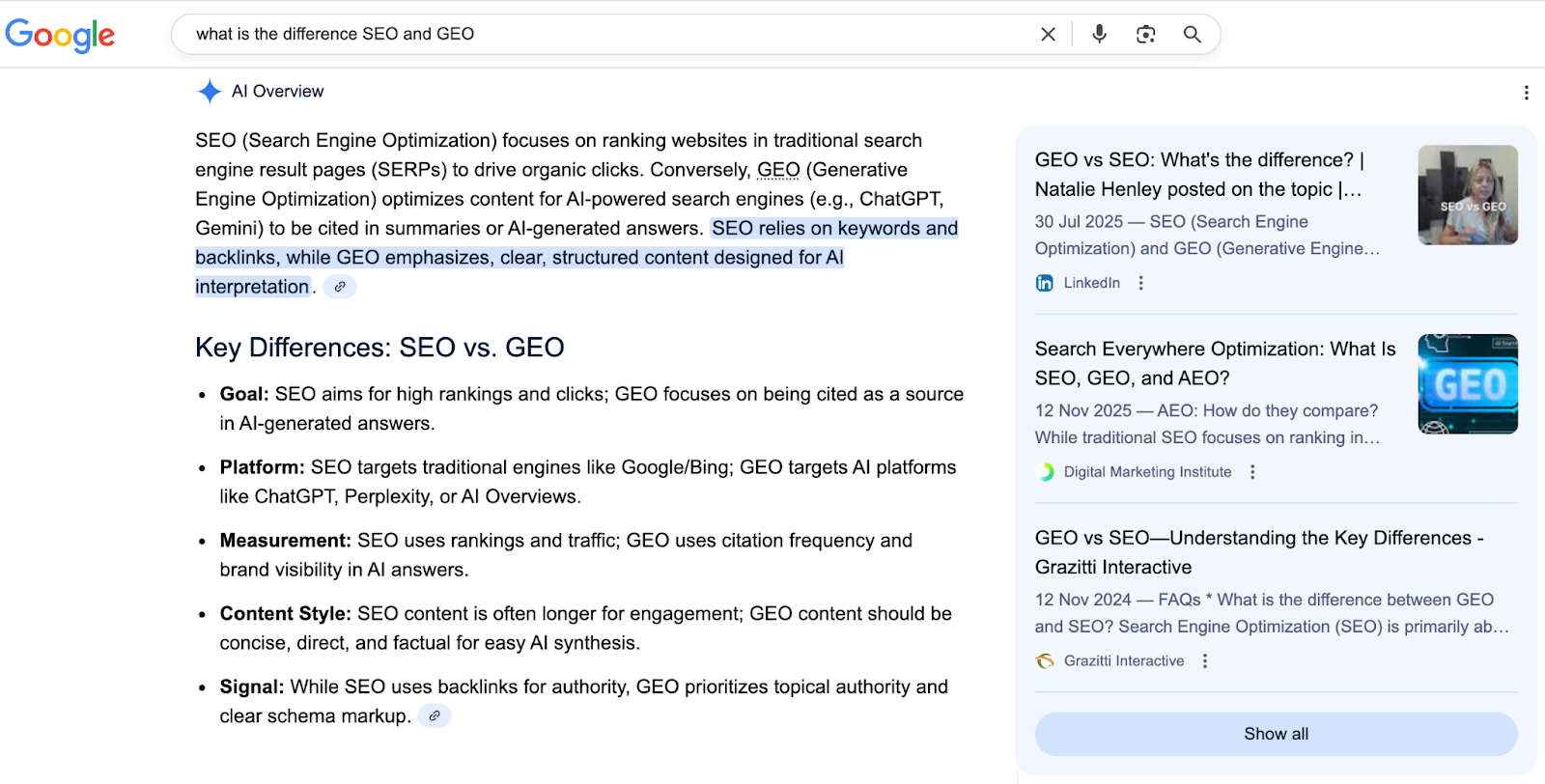
Your brand name or information appears in an AI-generated answer without a clickable link that directs users to your website. Early UX data suggests that when an AI Overview appears, desktop outbound click-through rates can drop by roughly two-thirds, while mobile traffic can lose nearly half its clicks.
This shift changes how you measure success. SEO success shows up in analytics as sessions, page views, and conversions from organic search traffic. GEO success manifests as brand visibility and authority, even when users never visit your site. Your brand might influence purchasing decisions or establish thought leadership through AI citations without generating a single click. This requires rethinking your core KPIs and recognizing that zero-click visibility still delivers business value through brand awareness and trust-building.
Click-Through Journey vs. Zero-Click Answers
SEO operates on a click-through model: users see your result, evaluate the snippet, click the link, land on your page, and then engage with your content. You control the full experience once they arrive, from page layout to conversion paths. GEO leans toward a zero-click answer model: the AI synthesizes information from multiple sources and presents a complete answer directly in the interface.
Comparison: SEO vs. GEO Key Differences
Here's how the fundamental aspects of SEO and GEO compare, highlighting why each requires its own strategic approach:
Optimization Timeline and Measurement Approaches
Measuring progress looks completely different when comparing SEO vs. GEO. SEO provides abundant data through tools like Google Search Console and Google Analytics. You track keyword rankings daily, monitor organic traffic trends, measure click-through rates, analyze user behavior on-site, and calculate conversion rates. These metrics give you clear feedback loops – make a change, wait a few weeks, and see how rankings or traffic respond. Attribution is relatively straightforward: you can see which queries drove visits and which pages converted those users.
GEO measurement remains less developed because the tools and standards are still emerging. You can't easily track how often AI systems cite your brand or how those citations influence brand perception and purchasing decisions. You may see referral traffic from AI-powered search tools in your analytics, but that only captures the small percentage of users who click through. Platforms like Scrunch and Peec AI are starting to fill this gap by monitoring citations across AI engines, though comprehensive tracking remains challenging. This makes proving ROI harder and requires focusing on proxy metrics like mentions in authoritative sources, entity recognition signals, and qualitative assessment of AI responses to relevant queries.
At Entlify, we help B2B tech companies work through both traditional SEO and emerging GEO challenges. Our approach combines technical optimization, strategic content development, and authority-building tactics that work across both channels. While AI search traffic shows early gains across some client accounts, we're already tracking these new patterns and adjusting strategies to position our clients for visibility as the search environment continues to shift. Contact us to discuss how we can build a search strategy that prepares your brand for both current and future search channels.
Conclusion: Why You Need Both GEO and SEO
The split between traditional search and AI-powered answers continues to grow. Understanding what is the difference between GEO and SEO gives you a framework for building visibility across both channels. SEO drives clicks and traffic through ranking pages in search results. GEO builds authority by getting your brand cited within AI-generated responses. These aren't competing strategies – they're complementary paths that serve different user behaviors. Most traffic still comes from traditional search, but AI citations influence how people perceive your brand before they ever reach your site. Effective allocation means investing in SEO for immediate traffic wins while building the entity signals and authoritative content that position you for GEO success. Start by auditing which channel delivers your current visibility, then strengthen the gaps. Track both click-through metrics and citation frequency as AI tools mature. The brands that prepare for both will own visibility regardless of how search continues to shift.
FAQs
What is the difference between GEO and SEO?
SEO optimizes your website to rank in traditional search results and drive clicks, while GEO optimizes your brand to be cited directly within AI-generated answers without requiring users to visit your site. The fundamental difference in GEO vs. SEO is that one focuses on clickable links and the other on zero-click brand mentions.
Do I need GEO if I already have a strong SEO strategy?
Yes, because user behavior is shifting toward AI-powered search tools that bypass traditional search results entirely. A strong SEO foundation helps, but GEO requires additional tactics like structured data implementation and building authority in datasets that AI models train on.
Does GEO replace SEO for digital marketing?
No, GEO complements rather than replaces SEO since traditional search still drives the majority of website traffic today. Understanding GEO vs. SEO as complementary strategies ensures you capture both click-through traffic and zero-click brand visibility as search evolves.
What metrics should I track to measure GEO performance?
Monitor brand mention frequency in AI responses, citation rates in authoritative sources, referral traffic from AI search tools, and entity recognition signals across platforms. These proxy metrics help gauge GEO impact even though comprehensive tracking tools are still emerging.
How can small businesses start implementing GEO tactics?
Begin by adding schema markup to your website, creating comprehensive FAQ content that answers common questions, and earning mentions in industry publications and directories that AI models likely train on. Focus on establishing your brand as a recognizable entity with consistent information across all platforms.