



Key Takeaways
To rank in AI Overviews, structure your content so each section delivers a direct, standalone answer within the first two to three sentences, backed by sourced data, validated schema markup, and strong E-E-A-T signals. Target informational, question-based long-tail keywords, keep content fresh on a 90-day update cycle, and ensure your technical foundations (Core Web Vitals, mobile responsiveness, crawlability) are solid so Google's Gemini model can reliably extract and cite your pages.
Google's AI Overviews are eating clicks. Pew found that when an AI Overview appears, traditional results are clicked only 8% of the time, compared to 15% when no AI Overview is present. If your pages aren't being cited in those AI-generated summaries, you're giving competitors visibility.
This AI Overviews ranking guide gives you a concrete, step-by-step process on how to rank in Google AI Overviews and get your content cited by Google's Gemini large language model. We'll cover the content signals that trigger citations, the structural changes that make pages “citation-ready," and the technical fixes that most teams overlook. Everything here applies to both existing and new pages. Whether you're running SEO for a SaaS startup or leading growth at an enterprise company, this is how you stay visible as search keeps shifting.
What Are Google AI Overviews?
Before you can rank in AI Overviews, you need to understand what they actually are, how Google decides what to show, and why they've become the single most important SERP feature for B2B visibility. Let's break it down.
The Basics: What They Are and How They Work
AI Overviews are AI-generated summaries that appear above all organic results on Google. They're powered by Google's Gemini model, which pulls information from multiple web pages simultaneously and synthesizes it into a cohesive answer. Think of it like a research assistant that reads dozens of articles and hands you a summary, complete with source links.
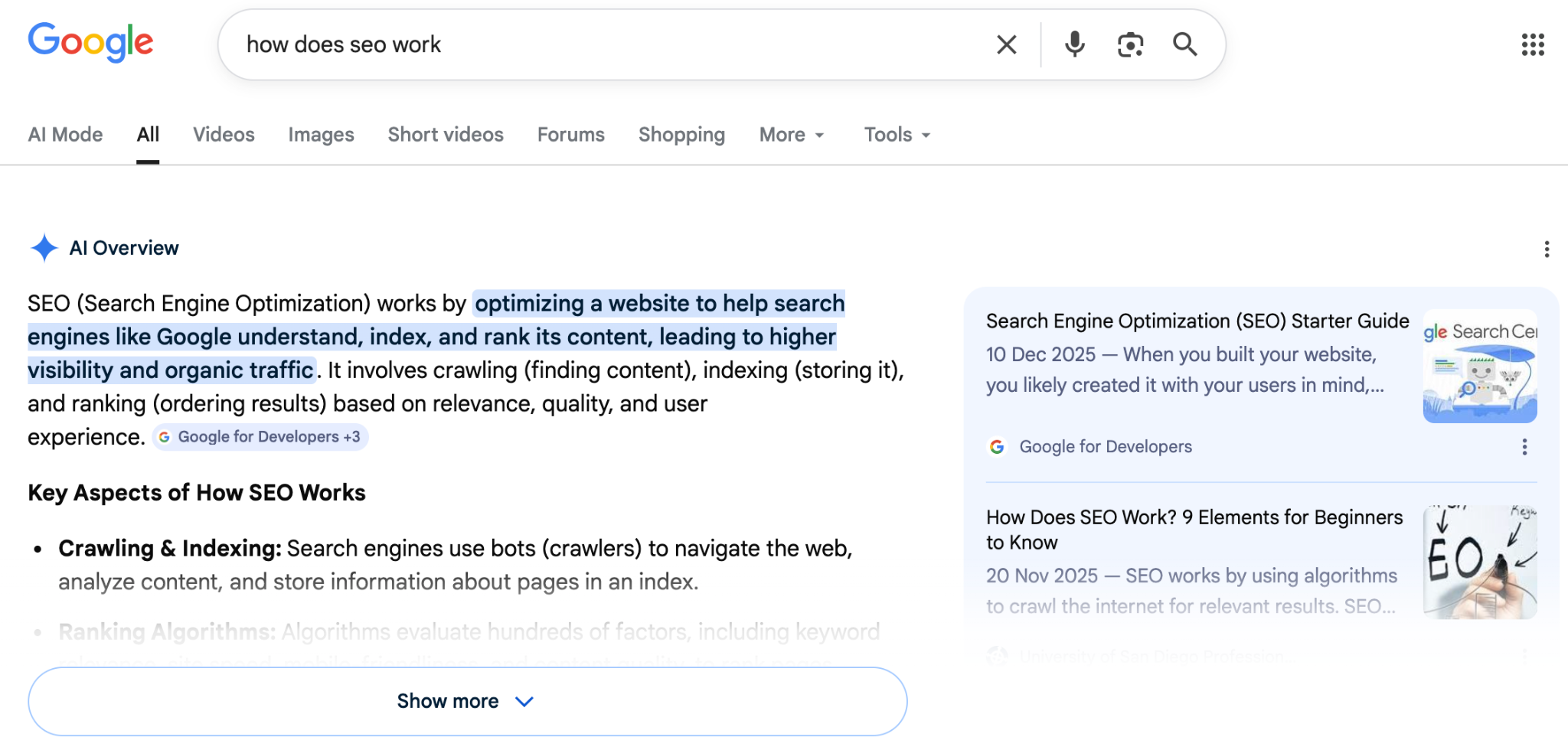
This is a major departure from featured snippets, which pull from a single source. AI Overviews cite multiple pages at once, allowing multiple brands to gain visibility from the same query. They've been live in over 100 countries since May 2024, and their presence on SERPs is only growing. If you want to understand the broader shift happening here, our breakdown of AI's impact on SEO covers the full picture.
What “Ranking" in an AI Overview Actually Means
There's no “position #1" in an AI Overview, the way there is in traditional organic results. When we talk about ranking in AI Overviews, we mean that your URL is cited as a source in the AI-generated response. The top-cited URL is visible without any interaction on desktop, so that spot carries real weight. But here's the catch: citations are not permanent. They can shift every time someone refreshes the same search. So this is less about holding a stable ranking and more about building consistent brand awareness with qualified traffic.
Why They Matter More Than Any Other SERP Feature Right Now
AI Overviews consume the majority of visible screen real estate, pushing traditional blue links below the fold. According to research from Ahrefs, AI Overviews have caused a 34.5% drop in click-through rate, with new research from Seer Interactive reporting drops of up to 61%.
For B2B companies and SaaS brands that depend on organic search to fill the top of their funnel, this changes everything. The old playbook of “rank on page one and wait for clicks" doesn't hold up when an AI-generated box answers the query before anyone scrolls. To keep track of how your content performs in these new formats, tools designed for AI search visibility tracking are becoming essential.
Query Types That Trigger AI Overviews (and Those That Don't)
Not every search gets an AI Overview. According to Ahrefs' analysis of 300K keywords, 99.2% of keywords that trigger an AI Overview are informational in intent, while commercial and transactional queries only have a 10% chance of triggering one. Short navigational queries (“HubSpot login"), branded searches, and anything Google can answer with a Knowledge Graph panel typically won't generate an AIO either. While AI Overviews are expanding, they primarily target informational and long-tail queries, but much less frequently on brand-specific terms.
So if you're optimizing product pages or bottom-of-funnel landing pages, AI Overviews aren't your primary concern. But if you're publishing educational content, how-to guides, comparisons, or anything that answers a research-stage question, you're directly in AIO territory.
Industries and Topics Where AIOs Show Up Most
AI Overviews tend to appear most frequently in industries where users ask complex, multi-layered questions: health, technology, finance, SaaS, cybersecurity, and B2B services. If your company operates in a space where buyers do extensive research before making a decision (which describes most SaaS and tech companies), your content is already in the zone where AIOs are most prevalent. That's both an opportunity and a risk, depending on whether you're the one being cited.
How Google Selects Which Pages to Cite in AI Overviews
Getting cited in an AI Overview isn't random, but it also doesn't follow the exact same logic as traditional organic ranking. Google evaluates pages through a specific set of signals, some familiar and some entirely new. Understanding these signals is how you move from guessing to knowing how to rank in AI Overviews.
Organic Ranking Still Matters, But It's Not Everything
Here's what trips up most SEO teams: they assume that ranking in the top 3 organically means they'll automatically appear in AI Overviews. That's not how it works. A significant chunk of AIO citations do come from pages that already rank in the top 10 organically, which means your baseline SEO still carries weight. But a large portion of cited pages sit outside the top 5 positions, and that's proof that traditional ranking and AIO citation are two separate games played on the same field.
What does this mean in practice? A page ranking #8 for a long-tail query can absolutely get cited over a page ranking #2, if that #8 page delivers a cleaner, more extractable answer. So yes, keep doing your organic SEO work. But don't treat a top-3 position as a guarantee. And don't dismiss pages that sit deeper on page one, because they might actually be your best candidates for AIO optimization. If you're still building your foundational keyword strategy, our guide on B2B keyword research is a solid starting point.
The Content Signals Google's AI Looks For
Google's AI doesn't read your page the way a human does. It scans for self-contained, extractable sections that can stand alone as coherent answers. Think of each H2 or H3 section as an audition. The AI is essentially asking, “Can I pull this out and drop it into a summary without it sounding incomplete?"
Here's a side-by-side comparison of how traditional ranking signals stack up against the signals that actually drive AI Overview citations:
The pattern here is clear: if you want to rank in Google AI Overviews, write each section so the first two sentences deliver a direct answer, followed by supporting detail. A clear H2/H3 hierarchy, short paragraphs, and bullets where they genuinely help readability all make extraction easier for the model. For a deeper look at how generative engine optimization works in practice, our guide walks through the full methodology.
Trust and Authority Signals That Influence Citations
As Rank Math's E-E-A-T guide explains, Google uses Experience, Expertise, Authoritativeness, and Trustworthiness to assess whether content deserves to rank, and this applies doubly for AI Overview citations. Pages with visible author credentials, sourced data, and first-hand experience get a measurable lift.
Pages with proper schema markup are roughly 3x more likely to earn AI Overview citations than pages without it. Schema isn't optional anymore, it's infrastructure.
Domain Authority as a standalone metric has lost much of its correlation with AIO citations. What matters more now is whether your page demonstrates topical authority on the specific question. A niche SaaS blog with original benchmarks on cloud security will beat a generic high-DA site publishing surface-level overviews of the same topic every time. Original data, cited sources, and transparent authorship are the trust signals that actually move the needle when Google's AI decides who to cite.
How to Rank in Google AI Overviews: 5 Steps
Now that you understand what Google's AI prioritizes when choosing citations, let's put that knowledge to work. Here's a five-step process for how to rank in AI Overviews that you can apply to both new and existing pages.
Step 1: Target the Right Keywords
Not every keyword triggers an AI Overview, so there's no point optimizing for queries that won't generate one. Focus on informational, question-based, long-tail queries, typically seven or more words. Phrases that start with “how," “why," “what," or “which" trigger AIOs at the highest rates. If the intent behind a keyword is transactional or navigational, skip it for this purpose.
Use Google's People Also Ask sections to map out question clusters around your core topics. The goal is to build a complete map of the questions your audience actually asks during research, then create content that answers each one directly.
Step 2: Structure Your Content for AI Extraction
Google doesn't read your page top to bottom the way a person would. It scans for standalone sections that it can pull out and drop into a summary. That means every H2 and H3 section needs to function as its own self-contained answer.
Open each article with a 50-70 word summary that directly addresses the primary query. Use question-based subheadings throughout. Keep paragraphs to three or four lines max, and use bullets or numbered steps where they genuinely improve clarity. If a section only makes sense after reading the one before it, rewrite it so it stands on its own. Think of each block of content as a potential snippet that Google could lift and place directly into an AI Overview.
Step 3: Build Your E-E-A-T Signals
Add author bios with verifiable credentials to every post. Cite primary sources (studies, official documentation, original data) rather than repeating secondhand claims. Include your own experience or proprietary data wherever possible, because Google rewards first-hand expertise over repeated information. Keep statistics fresh and update key figures at least every six months.
Accuracy is critical in search. AI Overviews are designed to surface information backed by top web results, so pages with sourced, verifiable claims have a clear advantage. If you want to take a deeper look at how AI tools can support your optimization efforts, check out our roundup of the best AI SEO tools available right now.
Step 4: Implement Schema Markup
Schema markup isn't a nice-to-have anymore. It's the structural metadata that helps Google's AI understand exactly what your content covers and how to categorize it. Here's the process for getting schema right on your AIO-targeted pages:
- Add FAQ schema: Apply this to any page that answers multiple related questions. It directly mirrors how AIOs synthesize Q&A content.
- Use HowTo schema: Add this to step-by-step guides and tutorials so Google can parse each step individually.
- Implement Article schema: Include author metadata, publish dates, and last-updated dates to reinforce freshness and authorship signals.
- Validate everything: Run your markup through Google's Rich Results Test before publishing. A broken schema is worse than no schema at all.
Following these steps consistently across your content library compounds the signal Google receives about your site's reliability and structure. Over time, this consistency builds trust with both users and the AI systems pulling citations.
Step 5: Handle the Technical Foundations
None of the steps above will matter if your site is slow, broken on mobile, or hard to crawl. Make sure your pages load fast and display clearly on any device: most people searching these topics are on their phones.
Clean up crawlability issues: fix broken internal links, resolve redirect chains, and confirm that no important pages are accidentally blocked from indexing. These aren't glamorous fixes, but they're the foundation that everything else sits on. Without them, even perfectly structured content won't get picked up by Google's AI when it's assembling an Overview.
Common Mistakes That Keep You Out of AI Overviews
You can follow every optimization step perfectly and still get zero citations if you're making one of these errors. Most of them are habits carried over from traditional SEO that simply don't translate to how Google's AI selects sources.
Writing for Keywords Instead of Questions
Stuffing a page with keyword variations and wrapping them in generic intros is the fastest way to get ignored by AI Overviews. Google's AI needs to extract a coherent, standalone answer. If the first three sentences of your section are background fluff before you get to the point, the model moves on to a page that leads with the answer.
The fix is straightforward: open every section with a direct response to the question posed in the heading. Context and nuance come after. Think of it like answering a colleague's Slack message: you give the answer first, then explain your reasoning. As SEO Discovery's AI Overview guide puts it, the opening line of your content is now the most significant ranking factor for generative search. If you're unsure which questions your audience is actually asking, a keyword relevance analysis can help you map the right question-intent phrases to each section of your content.
Ignoring Content Freshness
Stale statistics and outdated examples erode credibility signals fast. If your page still references 2022 data when newer figures exist, Google's AI will prefer a competing source that's current. Add “Updated [Month Year]" tags to your posts and refresh key figures at a minimum twice per year. A 90-day update cadence helps reset crawl timestamps and signals to Google that the page is actively maintained.
Treating It as a One-Off Tactic
Publishing one well-structured blog post and expecting consistent AIO citations is like planting a single seed and expecting a harvest. AIO visibility compounds over time. It's a content system built around recurring publishing and regular updates, not a single article. One optimized blog post won't move the needle. The brands that earn consistent citations are the ones producing a steady stream of question-intent content across their topic clusters.
Ignoring Structure and Schema
Walls of unbroken text are difficult for any AI model to parse and summarize. Missing schema markup leaves critical signals on the table. And without a clear heading hierarchy, Google can't map your content to the specific questions it's trying to answer. Here's how these mistakes stack up against what actually earns citations:
How Entlify Gets Clients Into AI Overviews
Each of these mistakes is fixable, but fixing them one page at a time doesn't scale. That's one of the problems that Entlify addresses. In practice, that means starting with an AIO content audit to identify which existing pages are citation-ready and which need reworking, then building a production pipeline of blog posts and landing pages targeting the informational queries your buyers are actually asking. We treat AIO as a moving target (because it is), so optimization is ongoing, not a one-time deliverable.
Contact the Entlify team if you need help identifying which pages need reworking and which are already citation-ready.
Conclusion
Learning how to rank in AI Overviews comes down to three things: answering questions directly, structuring content so an AI model can extract it cleanly, and backing everything up with credible signals. None of this is a one-time project. The brands that show up consistently are the ones treating AIO optimization as an ongoing system, publishing fresh, question-intent content on a regular cadence, and keeping existing pages current.
If you're serious about how to rank in Google AI Overviews, start with the pages you already have. Audit your top-performing informational content against the criteria in this guide: Is the answer in the first two sentences of each section? Is the schema implemented and validated? Are your stats sourced and recent? Fix the gaps on your strongest pages first, then expand from there. Use this AI overviews ranking guide as your audit checklist, it'll tell you exactly where you stand and what to prioritize next.
FAQs
Do I still need traditional SEO if I'm trying to rank in google AI overviews?
Yes, because pages that already rank well organically have a stronger baseline for earning AI Overview citations, even though a top-3 position alone does not guarantee inclusion. Think of traditional SEO as the foundation, and AI Overview optimization as an additional layer built on top of it.
Can I track which of my pages are being cited in AI overviews?
Yes. In Google Search Console, AI Overview impressions are included in the standard Performance report. Filter by query to identify which pages are triggering AIO appearances. For more granular tracking, GA4 can be configured to segment AI-driven traffic separately from standard organic.
How long does it take to start appearing in AI overviews?
There's no fixed timeline, but most teams see movement within 4–8 weeks of making structural changes to existing pages, assuming crawl and indexation are healthy. New pages take longer, since Google needs time to assess authority and freshness signals before pulling them into citations.
Does publishing more content help or is it better to optimize what I already have?
Start with what you have. Auditing and optimizing existing pages with some authority will move faster than publishing from scratch. Once your top pages are citation-ready, then expand with new content targeting question clusters you don't yet cover.
Will AI overviews eventually replace organic search entirely?
Not in the near term. Google still directs users to source pages, and cited content earns more clicks, not fewer. The more likely outcome is that organic search becomes more about brand authority and qualified traffic than raw click volume, which shifts the goal from ranking to being cited.