

Key Takeaways
A B2B content marketing funnel aligns your content with three buyer journey stages: TOFU (awareness) attracts prospects researching problems, MOFU (evaluation) helps them compare solutions, and BOFU (purchase) convinces readers to choose you. Success requires balancing investment across all three stages, mapping content to actual buyer behavior, and using the right formats and CTAs at each level to move prospects from strangers to customers.
A B2B content marketing funnel matches your message to each stage of the buyer's journey, from initial awareness through final purchase decision. TOFU content attracts strangers researching problems. MOFU material educates prospects comparing solutions. BOFU assets convince qualified leads to choose you. Most companies scatter their efforts across random content pieces without considering where each fits. This guide explains how each funnel stage works, what content types perform best at each level, and how to allocate your budget across TOFU, MOFU, and BOFU to generate consistent revenue.
What Is a B2B Content Marketing Funnel?
A B2B content marketing funnel is a structured framework that maps content to specific stages in your buyer's decision-making process. Instead of creating content randomly, you align each piece with where prospects are in their journey – whether they're just discovering their problem, evaluating solutions, or ready to make a purchase decision.
Think of it as an inverted pyramid. At the widest point (top of funnel), you're casting a broad net to attract anyone researching problems related to your solution. As prospects move down, the funnel narrows. Your content becomes more specific, addressing deeper questions about implementation, comparison, and ROI. When someone reaches the bottom, they're evaluating vendors and need proof that you're the right choice.
The Three Stages of a B2B Content Funnel
Understanding what prospects need at each level, and what they're not ready for yet, prevents you from pushing product features when someone's still learning basics, or serving educational content to someone ready to buy.
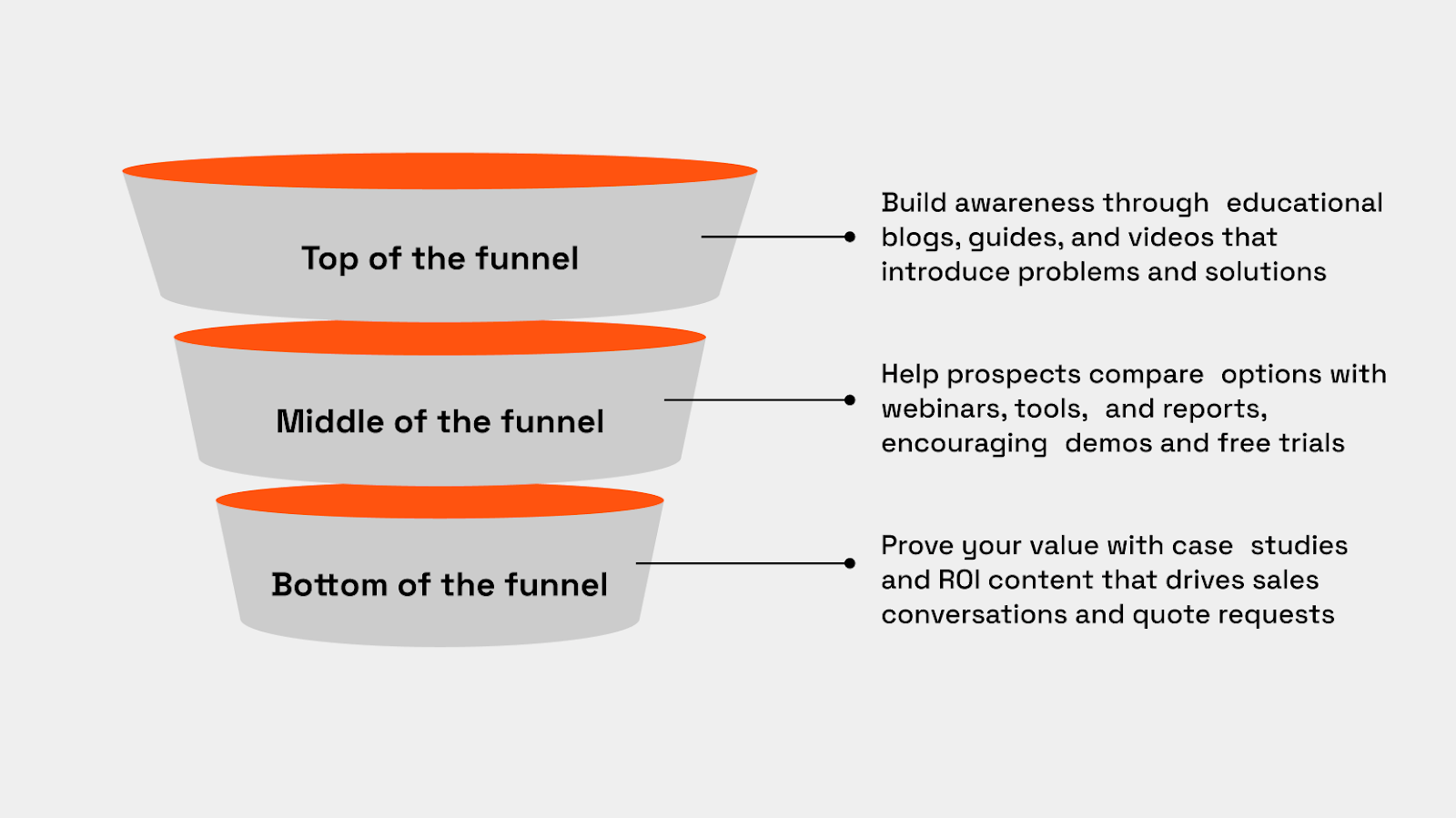
TOFU: Top of Funnel (Awareness Stage)
At the awareness stage, prospects identify problems or research the challenges they face. They're not looking for vendors yet, they're asking questions like “What causes ransomware attacks?" or “How do companies recover from data breaches?".
Your content here should educate without selling. Blog posts, guides, infographics, and explainer videos work best. For example, a cybersecurity company might publish “What is ransomware recovery: All you need to know". The goal is to build trust and establish your expertise – not to push product features.
Here's what performs well at the top of the funnel:
- Problem-focused blog posts: Explain industry challenges and their implications
- Educational guides: Break down complex topics into digestible concepts
- Industry research and trend reports: Position your company as a thought leader
- Video content: Introduce concepts visually for easier consumption
Your call-to-action should lead to related content – more blog posts, downloadable eBooks, or newsletter subscriptions. You're building an audience, not closing deals.
MOFU: Middle of Funnel (Evaluation Stage)
In the evaluation stage, prospects understand their problem and are actively comparing solutions. They're asking “How does this work?" and “What makes one solution better than another?".
Content shifts toward demonstrating how solutions function and what distinguishes different approaches. A MOFU title might be “Selecting the best solution for ransomware recovery". You're still educating, but now you're showing how your approach solves the problem.
Effective MOFU assets include comparison guides, webinars, free trials, and product demonstrations. Your SaaS startup CTO who read your TOFU content is now evaluating three vendors. They need detailed feature comparisons, implementation timelines, and pricing models – not surface-level benefits.
CTAs become more product-focused: “Start your free trial", “view a demo", or “Download our comparison checklist". You're guiding prospects closer to a decision.
BOFU: Bottom of Funnel (Purchase Stage)
At the purchase stage, prospects are choosing between finalists. They need proof that your solution delivers results and reassurance that they're making the right decision.
Content here emphasizes differentiation and real-world value. Case studies, customer success stories, ROI calculators, and implementation guides convince prospects to choose you. A BOFU title would be “The best ransomware recovery tool for your company", paired with case studies showing measurable results.
High-quality leads at this stage have clear pain points, timing, and budget signals – they're not just browsing. Your content should speak directly to procurement managers and decision-makers who need final justification for their choice.
BOFU CTAs focus on conversion: “Request a custom quote", “Talk to sales", or “View implementation plans". You're removing final objections and making it easy to say yes.
Content Characteristics Across Funnel Stages
This table breaks down how your content strategy should shift as prospects move through the funnel:
How to Choose the Right B2B Content Marketing Funnel Approach
Successful B2B marketing depends on how you balance your content across the different stages of a buyer's journey. Most companies fail because they dump all their resources into one area while ignoring the others.
If a procurement manager is ready to sign a contract, they won't care about your “Intro to Industry" blog posts. On the flip side, someone just starting their research isn't going to sit through a 40-page technical implementation guide. You have to match what you're writing to what the buyer is actually doing at that moment.
Mapping Content to Buyer Journey Stages
Effective content mapping starts with understanding how your buyers actually research and make decisions. According to Smaply, customer journey mapping helps businesses understand the customer's perspective by creating a visual representation of their experience with a product, service, or brand. This visualization reveals not just what content you need, but when prospects need it.
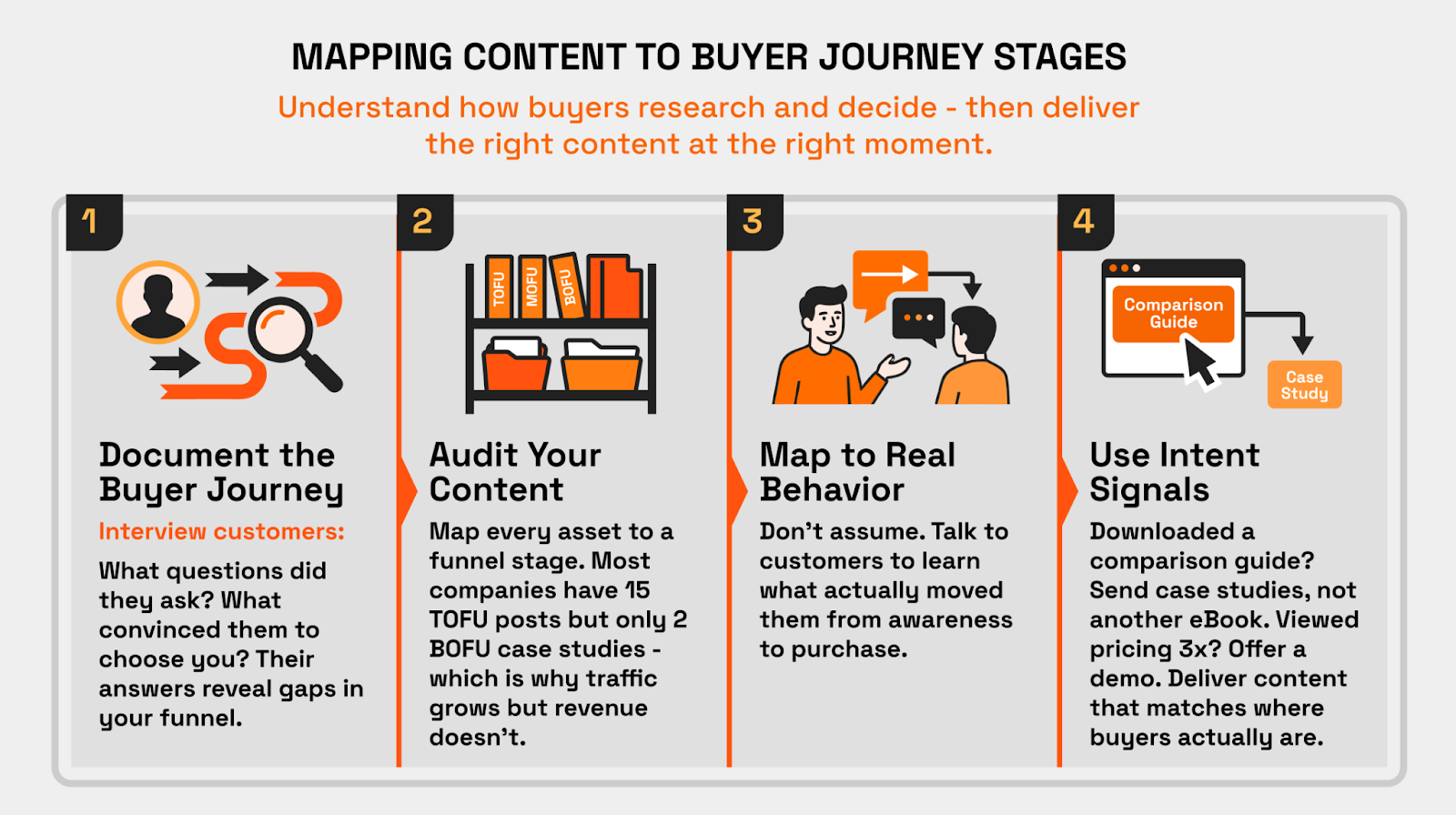
Start by documenting your typical buyer journey. Interview recent customers about their decision process. What questions did they ask first? Which resources helped them narrow their choices? What information convinced them to select you over competitors? These conversations reveal gaps in your current B2B content funnel. If you record or make notes of all your meetings with prospects, this info comes in handy, too.
Create a content inventory, mapping each existing asset to a funnel stage. Many companies discover they have fifteen TOFU blog posts but only two BOFU case studies. This imbalance explains why traffic grows, but revenue doesn't. Your cybersecurity startup might attract thousands of readers with “What is ransomware?" content, but without mid-funnel comparison guides and bottom-funnel proof points, those visitors never convert.
Use intent signals to trigger the right content. When prospects download your MOFU comparison guide, follow up with BOFU case studies – not another awareness-level eBook. Marketing automation platforms can track engagement across funnel stages and deliver progressively relevant content. A SaaS marketing director who views your pricing page three times is ready for a product demo, not a beginner's guide.
Balancing Investment Across TOFU, MOFU, and BOFU
Budget allocation across funnel stages should reflect your business growth goals. Early-stage companies need awareness, so 60-70% of the content budget flows to TOFU. Established brands converting known prospects shift resources toward MOFU and BOFU content that closes deals faster.
Different business scenarios require different funnel investments. Understanding where your company fits helps you allocate resources effectively and avoid common pitfalls:
Content Budget Allocation by Business Stage
Different business scenarios require different funnel investments. Understanding where your company fits helps you allocate resources effectively and avoid common pitfalls:

Track content performance by stage to refine your mix. If TOFU content drives massive traffic but few conversions, you likely need stronger MOFU assets to bridge the gap. If demo requests come in but deals stall, invest in BOFU content that addresses final objections – implementation timelines, security documentation, or integration guides.
Optimizing Your B2B Content Funnel with Digital Marketing
SEO helps your educational posts show up when someone searches for a specific problem. Once they’re on the site, conversion rate optimization (CRO) helps turn that random visitor into a lead. If organic rankings are taking too long to climb, paid search can jumpstart the process for the keywords that actually signal someone is ready to buy.
At Entlify, we build these funnels by connecting the dots between different channels. Our approach to B2B digital marketing looks like this:
- SEO: We target the “how-to" questions that build early awareness, but we also go after the solution-based keywords used by people who are already looking for a fix.
- CRO: we run tests to see which calls-to-action actually get people to move. This might mean swapping a generic “contact us" button for a free tool or a specific newsletter.
- Paid Ads: We use these to fill the gaps, making sure you show up for high-intent searches while your organic authority is still growing.
The most important part is making sure everything talks to each other. An organic blog post about security should naturally point to a comparison guide, which then leads into a case study. When these stages are linked, the funnel stops being a theory and starts being a system that generates revenue.
If you’re tired of publishing content that nobody reads, send us a message. We can look at your current strategy and find where the leaks are.
Conclusion
Your B2B content marketing funnel works when each stage serves a distinct purpose: TOFU builds awareness through education, MOFU guides comparison with detailed analysis, and BOFU eliminates purchase objections with proof. The companies that win don't just create content – they match it to buyer intent and distribute it strategically. Start by auditing your existing content against these three stages. Identify gaps where prospects drop off, then fill those holes with the right content formats. Track how visitors move between stages and refine your approach based on actual behavior, not assumptions. Balance your investment across awareness, evaluation, and purchase content according to your growth stage and business goals. Most importantly, connect your funnel stages so prospects naturally progress from one to the next without hitting dead ends.
FAQs
How long does it take to see results from a B2B content marketing funnel?
Most B2B companies see initial engagement metrics within 3-6 months, but meaningful revenue impact typically requires 6-12 months as prospects move through awareness, evaluation, and purchase stages at different speeds depending on deal complexity and sales cycle length.
Should I create all funnel content before launching my strategy?
Start with at least 2-3 pieces per funnel stage to ensure prospects can progress from awareness to purchase, then continuously add content based on performance data and gaps identified through customer interviews and analytics.
What's the biggest mistake companies make with their B2B content marketing funnel?
Over-investing in awareness content while neglecting middle and bottom funnel assets creates traffic without conversions – you'll attract visitors who never become customers because there's no content to guide them through evaluation and purchase decisions.
How do I know which funnel stage a prospect is in?
Track behavioral signals like content type consumed (blog posts indicate awareness, comparison guides show evaluation, pricing page visits suggest purchase intent), pages viewed per session, and specific CTAs clicked to segment prospects accurately.
Can I use the same content across multiple funnel stages?
While some comprehensive guides can serve multiple stages, content performs best when tailored to specific buyer intent – repurpose core ideas into different formats (awareness blog post, evaluation webinar, purchase case study) rather than forcing one piece to serve all stages.